
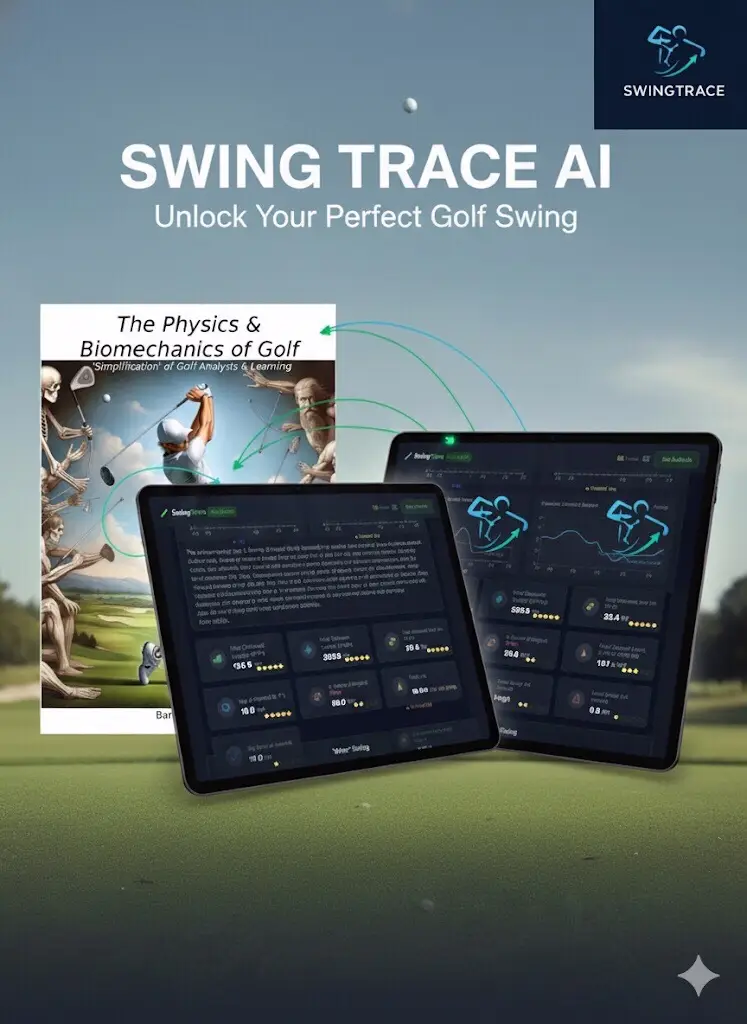
Swingtrace AI – a mobile app, making golf coaching and learning commensurate with perception, biomechanics & physical ability
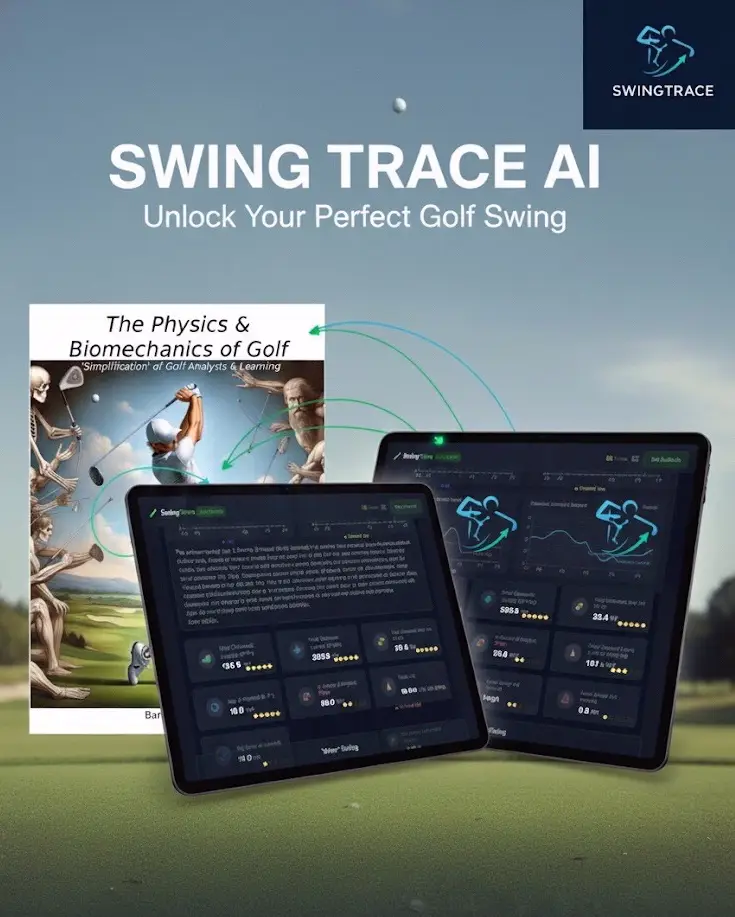
The Idea: Democratise & Deploy the Latest Golf Science Findings and Coaching Direction via a Simple, Affordable Mobile App
When I set out to write The Physics & Biomechanics of Golf, I wanted to bridge a specific gap I’d noticed for years. Actually there were two glaring gaps – the one between empirical academic findings and the typical popular coaching publication and methodology, but more importantly the one between ‘what golfers do and what they feel’.
As a product of contemporary golf theory, born as it was from deconstructive analysis (popularised by Ben Hogan) and more recently the rise of YouTube, much focus is placed on static swing positions and impact conditions. The importance of muscle physiology, physics and dynamic forces aside (which the book covers in some detail), in addition, little time is spent considering perception, specifically the feedback system that tells you where and how you are oriented in space. That system, as it relates to kinaesthetic feedback is called proprioception; it’s the foundation of all efficient athletic movement.
In the book, I explored how proprioceptive awareness shapes the golf swing – particularly in the backswing, where there’s enough signal propagation time available for the brain to process meaningful sensory input or change. Unfortunately the downswing is temporally limited, that is, it occurs too fast for meaningful feedback and thus conscious correction. Signal propagation to and from the extremities can take longer than the entirety of the downswing. Once underway, in reality any intervention must be pre-programmed by psychological intent, rehearsal training or directly via training intervention, including training aids (which should be approached with a dose of healthy scepticism).
Regardless, the single fact – that golf improvement depends on what the mind can feel or interpret, before it intervenes or programs new kinaesthetic neural connections, and also some appreciation of the physics involved in exercise and athletic movement – changed how I looked at training forever. (Coloured also by my academic background in Psychology and my vocational background in design & engineering.)
The Challenge: Turning Awareness into Training
Golf coaching has always wrestled with one major challenge: how to make complex movement trainable. Kinematics and kinetics of a good swing are fairly easily explainable, but unless a player can perceive the difference between (their) ideal motion and how they currently move, progress will be inconsistent or absent. Proprioception is the bridge between biomechanics and motor control – it’s what turns knowledge into movement. As I hypothesise in the book:
“Understanding and physiological self-awareness of the forces at play in the golf swing, pertaining to the biomechanics required to accommodate and maximally take advantage of those forces via opposing pressures and kinematics for example, would demonstrably benefit all golfers if effectively communicated as first principles.”
Yet until now, we haven’t had a good way to communicate, perceive and visualise forces, let alone relate and adapt them to appropriate kinematics, that is, beyond prohibitively expensive force plate or motion capture setups. Ball and clubface measurements have become commonplace. Empirical data on the players movement patterns has lagged behind and largely remained the preserve of elite sports science labs.
The Solution: Visualising the Invisible
That’s where Swingtrace AI began. Built on the same biomechanical framework as The Physics & Biomechanics of Golf, Swingtrace uses AI and computer vision to detect and track joint motion into key swing positions (P2–P7). But more importantly, it connects those data points to the forces that players can feel and more importantly, manipulate.
It’s not about analysing every millisecond, or overloading the golfer with numbers – it’s about creating a means of synchrony between perception, dynamics and performance. Golfers can finally see what their proprioceptive feedback has been trying to communicate to them all along.
From Text to Technology
In a way, Swingtrace AI is simply the next chapter of the book. Where The Physics & Biomechanics of Golf explored the theory – the why and how of movement – Swingtrace applies those principles in near real time, using visual models, physics modelling, machine learning and AI analysis to help golfers refine their sensory awareness and movement.
The app doesn’t in any way attempt to replace coaching. It hopefully enhances it, offering a bridge between scientific understanding and experiential learning. Coaches gain a biomechanical lens; players gain awareness they can then feel, adapt and relate performance metrics to.
What’s Next
The first trailer for Swingtrace AI is out now: now https://youtube.com/shorts/mSMDy58dvvk?si=PU3XVtoDsXfcfCPb. The second will be out in the very near future, a small but exciting milestone in what’s been a long journey from biomechanics research to applied golf technology. I will be unveiling features and real world use cases and examples as we move through these initial trailers. I would very much appreciate your support, that is, just in the form of registered interest (you can find the link or QR code to the Swingtrace apps landing page, below).
If you’ve followed my work, you’ll be aware it’s about relating science and technology to ‘practical understanding’. An over reliance on the myriad of metrics from launch monitors, valuable as those may be, tells a golfer very little about their physical dynamics. The goal is to give golfers the tools required to develop movement intuition, intent and adapt, not just to provide another technical layer of motion data.
I will be offering a limited number of free Swingtrace AI analysis reports, along with my personal input. If this kind of technology might be of benefit to your game or coaching, I am genuinely looking forward to sharing this next step and hearing from players, coaches and the sports science communitity. If you would like to get involved, find out more or register your interest, click below:
All the best.

We author, publish and sell our books here in the UK, along with our worldwide distributors including Amazon. As an Amazon Associate, ‘golfbiomechanics.net’ earns from qualifying purchases on affiliated products. This means that if you click on an affiliate link and make a purchase, ‘golfbiomechanics.net’ may receive a small commission at no additional cost to you. Thank you for supporting this website and helping us continue to provide the best possible, valuable content!

Leave a Reply