

A players interaction with the ground facilitates the generation of torques, rotations and velocities in the golf swing. One would not generate much clubhead speed while floating about in space! Swing theory in this regard appears to have progressed through three discrete phases over recent decades. I am not a golf historian; consider the following then as more of an impression, rather than strictly chronologically accurate. Anyway those three stages can approximately be defined as follows:
- Weight transfer / shift (pre 1990s)
- Weight loading (Leadbetter et al, mid 1990s – early 2000s)
- Joint loading (circa last 10-15 years)
Semantics wise at least, the first two of the above are problematic. The first (transfer / shift) could be taken to imply ‘a lateral shift of mass away from the target’. The second, one could easily imagine might encourage excessive hanging onto one’s trail side. The third is much better descriptively. It removes the notion of the players mass or even centre of mass entirely, substituting primarily for vertical forces. Namely, the oppositional affects of ‘ground reaction force’ (GRF).
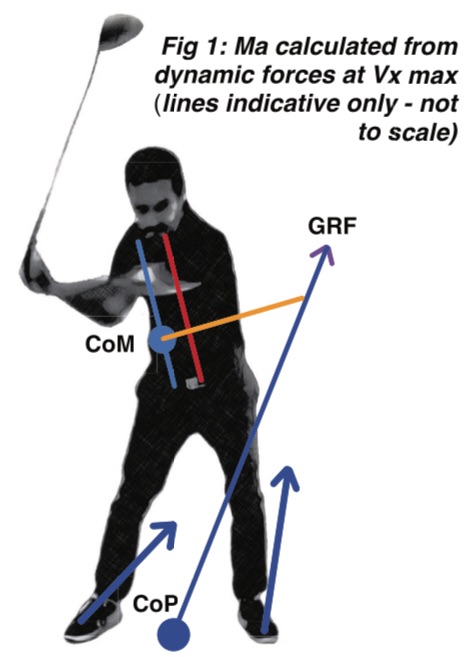
Nevertheless, centre of mass (CoM) is crucial to the generation of torque and therefore ultimate clubhead speed. Of particular import, is its’ location medial-laterally (trail or lead side) at various points in the swing. The primary predictor of torque is the length of the players moment arm (Ma). (Moment arm is the orange line in the above image.) Of critical importance, you can see Ma is measured from the players CoM. All other things remaining equal then, during the downswing a more trail-ward CoM lengthens Ma, amplifying resultant torque. But…
‘consciously trying to move CoM laterally is unreliable. It can all too easily lead to lateral shift or sway, on and off of the ball.’
CoM should be manipulated via correct dynamics and sequencing only and thus should pretty much take care of itself. Long drive competitors often focus on the vertical component of weight or mass shifts, over the lateral. For normal competition golf, accuracy is just as important, if not more so than distance. For this reason I would suggest that in the main, forgetting about CoM altogether is a pretty good idea.
It is a common misconception that ‘full loading’ occurs at the top of the backswing. This is incorrect and possibly a manifestation of the trend to sit or squat into the backswing, as popularised a few years back. Loading (of a joint) is a consequence of GRF. In physics parlance GRF is (loosely) defined as the force of the ground pushing upwards, in static equilibrium to the players dynamic mass. Looking at GRF traces of elite players atop of force plates then, what may surprise you is that…
‘ground reaction reaches maximum in the backswing when the lead arm is parallel to the ground.’
Thus, there is actually no requirement to hang trailward. There exists no reason to increase pressure (or ‘weight load’) under the trail foot excessively throughout the backswing. Subsequently, during the downswing maximum GRF occurs roughly as the club shaft orientates parallel to the ground. By this point GRF has moved lead-ward. By impact the lateral component of lead foot GRF vector may actually be traveling away from the target.
So what is to be taken from this? Two things I would say are of upmost importance, at least initially when considering swing changes.
- Firstly, the ability to recognise force traveling vertically upwards into the pelvis trailside in takeaway.
- Secondly, avoiding consciously shifting mass around during the golf swing in general.
I truly believe that sound swing dynamics requires a base understanding of muscle physiology, in a mechanical and dynamic sense. It is crucial to know what musculature does what and when, in terms of the required biomechanics. Also, one requires some appreciation of the physics involved. Centre of pressure (CoP) is for another day, but changing the location and direction of CoP (for reasons discussed in the book) is far more effective in generating torque than Com. It encourages far less mediolateral displacement (sway) also.
‘Shifting centre of pressure (CoP) around in the golf swing is very different to shifting centre of mass (CoM).’
Mimicking, positional rehearsal and repetition is commonplace in contemporary golf coaching. I don’t believe that in isolation this is either the easiest, or most efficient modality of learning for most. It fails to give a sense of the forces and dynamism involved. The swing is a dynamic process, thus should be learned as such. My undergraduate degrees was actually Psychology. I can say with some certainty then, that for a particular type of learner, this methodology will be pretty much fruitless. At least for a minority subset of golfers, it will fail in terms of maximising potential. Which is what led me to write ‘The Physics and Biomechanics of Golf’ in the first place.
If you have, thank you ever so much for taking the time to read this blog.
All the best.


Leave a Reply